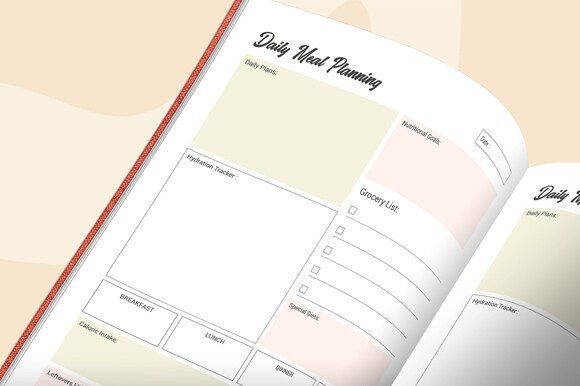
Simplify Meals with a Daily Meal Planning KDP Interior
Staying organized around nutrition often feels like a second job. Between tracking ingredients, coordinating family preferences, and sticking to health goals, it’s easy to lose focus. A well-structured daily meal planning KDP interior solves that problem by giving you, your clients, or your customers a single, reliable place to log every meal, snack, and hydration detail. The interior doesn’t just list boxes to fill—it’s a complete 109-page framework designed for immediate use, whether you’re printing batches for personal accountability or publishing a polished planner on Amazon KDP.
This tool combines practical size, high-resolution artwork, and editable source files in formats like AI, PDF, JPG, PNG, and PPTX. That means you aren’t locked into one final look. You can adapt headers, adjust prompts, or add your own branding before hitting print. And because it’s already formatted for KDP’s requirements—with a clean 8.5 x 11 inch trim, no-bleed pages, and 300 DPI output—you skip the technical guesswork that slows down many publishing projects.
What Makes a Meal Planning KDP Interior Different
Most generic notebooks leave users staring at blank lines, unsure where to start. A dedicated daily meal planning planners for personal, commercial, or KDP business changes that by offering guided yet flexible sections. The interior you’re considering includes structured spaces for breakfast, lunch, dinner, and snacks, plus sections for water intake, notes on energy levels, and reflection prompts. This layout isn’t about rigid rules; it’s about creating a habit of mindful eating that works for individuals, dieticians, or lifestyle bloggers who want to publish their own branded planners.
Because the pages are consistent and cleanly aligned, users can flip through weeks without overwhelm. The logbook aspect encourages daily check-ins, while the overall design supports long-term pattern recognition—someone might notice they feel sluggish after skipping protein at lunch, or that their hydration dips on busy Wednesdays. For commercial publishers, that same design consistency translates into higher customer satisfaction and fewer returns on platforms like KDP.
Why the No-Bleed, 8.5 x 11 Inch Format Matters
Many print-on-demand interiors trip up publishers with bleed requirements that demand extra margin calculations. This core daily meal planning KDP interior removes that hurdle entirely. With no bleed, each page’s content sits comfortably within a standard printable area. You can send the files to a local print shop, use your home office printer, or upload directly to KDP without adjusting dimensions. The 8.5 x 11 inch size is large enough to write in comfortably while still fitting standard binders and folders, making it a practical choice for anyone from busy parents to nutrition coaches who print weekly handouts.
The 300 DPI resolution ensures that text, tables, and subtle design elements remain crisp. When customers flip through a printed copy, they shouldn’t see pixelated lines or fuzzy date boxes. High-quality printing reinforces the planner’s credibility, whether it’s used privately or sold as a branded product. For small business owners who run local stationery shops, having a ready-to-print file for in-house production eliminates the back-and-forth with designers and cuts turnaround time dramatically.
Editable Source Files Put You in Control
A static PDF works well for immediate use, but life and brand needs change. That’s why having access to the source AI file, along with alternate formats like PPTX, PNG, and JPG, turns a simple logbook into a customizable system. You might run a health coaching practice and want to swap generic section titles for your own terminology, or a KDP seller might want to adjust the cover matching interior for a seasonal series.
Even small tweaks—changing font sizes, adding a motivational quote at the bottom of each page, inserting a custom logo—help differentiate your version from others on the marketplace. With the PPTX file, non-designers can make basic edits in PowerPoint before exporting fresh PDFs. Photographers and content creators might use the PNG or JPG pages to create social media previews or printable samples for email newsletters, showing the interior’s layout without giving away the entire product.
This flexibility supports more than just aesthetic changes. Someone managing dietary restrictions for multiple family members could duplicate pages and assign different color codes for gluten-free, dairy-free, or low-sodium plans. The editable nature means the tool evolves with its user rather than becoming outdated after a few weeks.
Who Benefits Most from a 109-Page Meal Planner Interior
The obvious audience includes self-publishers and KDP entrepreneurs looking for low-content book interiors that sell consistently. Meal planning, wellness journals, and food diaries remain popular niche categories, and having a ready-to-upload 109-page PDF saves weeks of layout work. But the value extends further.
- Health and wellness coaches can print branded copies for clients, using the planner as a conversation starter during check-ins. The daily structure encourages compliance without feeling like homework.
- Busy parents who juggle multiple schedules often appreciate a single weekly spread where they can note what each family member ate, plan grocery lists, and track picky eating patterns.
- Personal chefs and meal prep services might use the interior as an internal tool to log client preferences, allergies, and feedback, keeping all critical information neatly organized.
- Bloggers and influencers in the food space can adapt the source files to create a lead magnet, offering a free printable version of a few pages in exchange for email sign-ups, then linking to the full published planner on KDP.
- Individuals managing specific health goals (blood sugar regulation, weight maintenance, post-workout nutrition) find that a dedicated logbook reduces the temptation to mentally estimate portions and then forget by evening.
In each scenario, the interior serves as a foundation. Users aren’t starting from scratch; they’re building on a proven structure that already accounts for printing standards, readability, and daily usability.
Practical Scenarios Where This Planner Shines
Consider a freelance nutritionist who runs workshops on mindful eating. At the end of each session, attendees receive a professionally printed booklet—the same daily meal planner interior, customized with the nutritionist’s logo and contact details. Participants go home with a tool that reinforces the workshop’s lessons, and the nutritionist gains ongoing visibility without additional effort.
Or picture a KDP seller testing different interior themes. They might take the base AI file, adapt the color palette and line styles to match a boho cover design, and upload the 109-page interior in minutes rather than days. The no-bleed formatting gives them confidence that the file will pass KDP’s automated checks without last-minute rejection due to margin errors. Over time, they can spin variations—a vegetarian-focused version, a fitness meal tracker, a family meal log—all from the same structural core.
On a personal level, someone recovering from a medical procedure might use the planner to track fluid intake alongside solid meals. The simple act of writing down each glass of water next to the meal sections helps them stay accountable while they heal. Having a consistent, undated layout means they can start any day of the year without wasting pages.
What to Check Before Committing to Any KDP Interior
While this planner solves many common pain points, it’s still smart to evaluate fit. The editable AI file requires basic familiarity with Adobe Illustrator or similar vector software; if you only need quick PDF tweaks, you might find the PPTX option more approachable but with slightly fewer advanced editing features. The 109-page count provides substantial content, but if your specific niche demands a slimmer or more journal-heavy layout, you may need to adapt or combine with other resources.
Also, the absence of bleed means the design stops at the page edge with no background color or image extending to the trim. That’s ideal for clean, minimal interiors, but if you envision full-page color backgrounds that print edge-to-edge, you would need to work with bleed files. The high-quality 300 DPI printing ensures sharp results on standard printers, but double-check that your local print provider or KDP’s process matches the file specs; the included PDF is ready for upload, but it’s always wise to order a proof copy before scaling up sales.
For commercial users, note that this interior is built to be a versatile template. It doesn’t include pre-written meal ideas or nutrition advice, which leaves the content open for you to brand as your own but also means you must provide any educational material separately if that’s part of your offering.
How to Integrate the Daily Meal Planning Interior into Your Routine
Start by printing a single week’s worth of pages if you’re using the planner personally. Place it on the kitchen counter or inside a binder you carry to work. The key is to fill it out at the same time each day—maybe while drinking morning coffee for planning, or right after dinner for reflection. Over time, the logbook becomes a non-negotiable part of your routine, much like brushing your teeth.
For KDP publishers, launch by researching what’s currently ranking in the food journal and meal planner categories. Then, pull the source files and tailor the interior’s section titles and styling to match an underserved subtopic. Upload the PDF, set your pricing, and use the high-resolution JPGs to create marketing imagery for social media. Because the interior is designed to be print-ready, you can confidently promote it knowing that customer reviews will reflect a professional look and feel.
Coaches and professionals might laminate a sample page to keep in a visible spot during consultations, referencing it while discussing clients’ nutrition habits. Offering the digital source files as a bonus for package clients adds perceived value without requiring extra work—just direct them to a custom-printed version through your recommended print service.
The Long-Term Advantage of a Cohesive Planning System
Disorganized meal tracking often leads to abandoned goals. A daily meal planning KDP interior prevents that by keeping every important detail—macronutrients, hydration, timing, mood, and personal notes—bound together in one volume. The 109-page length provides enough space for a full quarter of daily entries, plus room for summary pages if you choose to add them. Users don’t have to hunt through phone apps, sticky notes, or scattered spreadsheets. Everything lives in one place, whether that’s a printed book, a digital PDF filled out on a tablet, or a customized print-on-demand product.
For business owners, the shift from concept to sale compresses dramatically when you don’t have to design an interior from scratch. You can spend your energy on cover design, niche research, and marketing—activities that directly influence discoverability and sales rank. The combination of AI, PDF, JPG, PNG, and PPTX files means you’re not limited to a single platform either; the same interior can power a printable Etsy listing, a KDP paperback, and a lead magnet on your blog simultaneously.
Ultimately, the strongest meal planners go beyond simple tracking. They invite users to reflect, notice patterns, and make small adjustments that compound over weeks. That’s the quiet strength embedded in this interior’s layout—and why so many creators, coaches, and everyday consumers find it a reliable tool in their personal or commercial toolkit.