Mastering Logic with Kakuro Puzzles Classic Type: A Practical Resource for Daily Cognitive Training
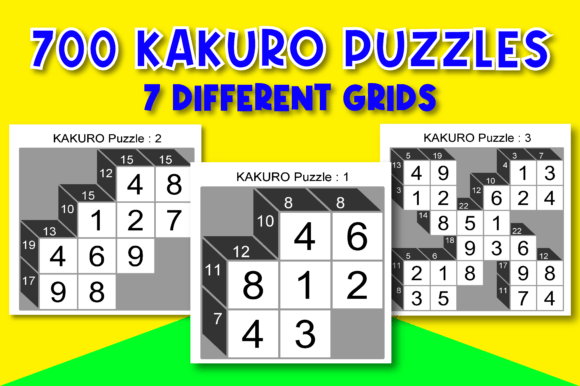
Kakuro puzzles, often described as a cross between crosswords and sudoku, deliver a uniquely satisfying blend of arithmetic and lateral thinking. The Kakuro Puzzles Classic Type collection provides a structured, no-fuss way to engage with this brain game at any skill level. With 700 puzzles distributed across seven distinct grid sizes, this set turns a single activity into a scalable mental workout. For professionals, creators, and anyone who values sharp decision-making, these puzzles are not just a pastime—they are a deliberate tool for maintaining clarity under pressure. The object is straightforward but deceptively deep: fill all empty squares with numbers 1 to 9 so that the sum of each horizontal block matches the clue on its left, and each vertical block matches the clue on its top. No number can repeat within a single block. That constraint alone forces a kind of systematic creativity that translates well into real-world planning and execution.
What makes this particular package stand out is its immediate usability. The download includes high-resolution PNG files at 300 DPI, ensuring crisp output whether you print them at home or use them on a tablet with a stylus. Solutions are included, which matters more than many realize. Having answer keys transforms the puzzles from a high-stakes test into a deliberate practice system. You can attempt a grid, check your logic, identify exactly where an assumption went wrong, and retrace your steps. That loop—attempt, review, correct—is identical to the feedback cycles used in editing content, debugging code, refining marketing funnels, or iterating on a product prototype. Kakuro becomes a low-risk sandbox for building persistence and error-correction habits.
How the Puzzle Structure Mirrors Process-Oriented Thinking
Kakuro is not a game you solve by staring and waiting for inspiration. It demands a methodical unpacking of intersecting constraints. Each clue sits at the head of a row or column, and those clues overlap. A number you place in a shared cell must satisfy two separate sums simultaneously. This is the same mental posture required when balancing a project timeline with a budget, or when aligning a design aesthetic with technical limitations. You cannot optimize one variable in isolation. The Kakuro Puzzles Classic Type grids make this constraint visible and tangible, especially as you move from smaller grids to the larger, more intimidating layouts.
The seven grid sizes included act as natural skill gates. Beginners or those looking for a quick five‑minute reset can start with compact puzzles that use smaller block combinations. As comfort grows, moving to larger grids introduces longer sum‑chains, more interdependent cells, and a heavier reliance on deduction rather than brute‑force trial. This progression mirrors how we onboard into complex software, learn a new language, or adopt a strategic framework: start with the simple patterns, then let complexity accumulate organically. By the time you tackle a dense 24‑clue grid, you are not working harder than before—you are working with a more refined internal toolkit. The puzzles themselves teach you to spot “unique sum” patterns, like the fact that a two‑digit sum of 3 can only be 1 and 2, while a sum of 4 can only be 1 and 3. Internalizing these building blocks feels like learning keyboard shortcuts: small investments that yield long‑term speed gains.
Practical Placement: Before, During, or After Focused Work
One of the most overlooked uses of a puzzle collection like this is its role as a transitional ritual. Because each Kakuro puzzle has a definite endpoint, it provides a clean cognitive break without the infinite scroll of social media. Many professionals use a single puzzle as a “warm‑up” before diving into deep work. The act of holding a few constraints in working memory, scanning for logical openings, and methodically eliminating possibilities wakes up the prefrontal cortex without the cortisol spike of checking emails. It is akin to a singer doing vocal scales—low stakes, high relevance.
During a project, especially one that involves long periods of independent focus, a short Kakuro session can serve as a deliberate interruption. Rather than fighting mental fatigue until it forces a mistake, stepping away for ten minutes to solve a puzzle on paper gives your attentional system a rest while keeping the brain in an analytical mode. The tactile nature of printing a 300 DPI sheet and using a pencil adds a sensory shift that screens alone cannot provide. After a project milestone or at the end of the day, a harder grid becomes a satisfying way to close the loop. Because the solutions are provided, you do not leave the puzzle unresolved and carry lingering uncertainty into your evening. You either complete it correctly or you learn precisely where your logic faltered. That closure is undervalued in a world of perpetually open tabs and inboxes.
Integrating Kakuro Puzzles Classic Type into a Learning or Creative Workflow
Creators and educators often need low‑prep resources that sharpen quantitative reasoning without being overtly academic. The Kakuro Puzzles Classic Type collection fits cleanly into a morning routine, a classroom warm‑up, or a workshop icebreaker. Because the rules are simple enough to explain in under a minute, groups can start working immediately. The game quietly reinforces addition, number sense, and logical deduction, but it never feels like a math drill. That makes it especially useful for educators who want to build numeracy confidence in adults returning to learning, or for team leads who want a collaborative thinking exercise. Print several copies of the same grid and see how different minds approach the same constraints—some work from the smallest sums outward, others hunt for intersections with the fewest possible combinations. That variation in strategy is a conversation starter about problem‑solving styles.
For writers, designers, and marketers, the puzzles offer a way to detach from verbal or visual overload and enter a purely structural headspace. A common friction in creative work is the temptation to edit while generating. Kakuro actively punishes that. If you try to fill cells too early without mapping candidate numbers, you will create conflicts that ripple outward and force a full restart. The practice of patiently holding possibilities, noting them in margins, and advancing only when a cell becomes unequivocally determined is a direct parallel to the “write first, edit later” principle. Over time, you start to recognize when you are guessing rather than deducing—a critical distinction in any decision‑based role.
Building a Long‑Term Habit with 700 Puzzles
Consistency matters more than intensity in any mental training regimen. Having 700 puzzles across seven grid types removes the friction of searching for the next appropriate challenge. You can set a simple rhythm: one small grid each morning, two medium grids during the week, and a larger puzzle reserved for a quiet Sunday afternoon. Because the grids are delivered as individual PNG files, you can organize them into folders by difficulty, print a batch for a trip, or load them into a digital notebook app that supports image annotation. The 300 DPI resolution ensures that even when printed at full page size, the clues remain sharp and easy to read—a small detail that matters when you are squinting at tiny numbers after a long day.
From an organizational standpoint, pairing the puzzle sheets with a simple log can amplify the benefits. Jot down the date, grid size, time taken, and one note about where you got stuck or what strategy clicked. Over months, this log becomes a personal dataset on your own cognitive patterns. You might notice that your speed on small grids improves steadily, but that larger grids reveal a tendency to overlook intersecting blocks. That kind of insight is actionable. You can then deliberately focus on the grid type that pushes your growth edge, which is a far more efficient use of time than aimlessly solving random puzzles. This feedback loop—solve, record, review, adjust—is the same process that drives continuous improvement in business, fitness, or any skill‑based domain.
Quality, Compatibility, and Long‑Term Value
Digital puzzle collections often suffer from poor formatting, inconsistent grids, or missing solutions. The Kakuro Puzzles Classic Type package addresses this directly by providing ready‑to‑print PNG files at 300 DPI and including complete solution sets. The clarity of the grids is essential for minimizing eye strain and preventing misreads. When a puzzle is densely filled with candidate notes, a blurry clue or a faint grid line can lead to unnecessary errors. High‑resolution output ensures the experience remains clean whether you use a laser printer, an inkjet on standard paper, or a digital pencil on a high‑dpi screen. The inclusion of solutions also future‑proofs the collection. Months after you first print a batch, you can revisit a puzzle you abandoned, check the solution, and study the logic path that eluded you. That archival value turns a simple puzzle book into a reusable reference for logical patterns.
Another often‑overlooked benefit is the separation of puzzle and solution files. You can keep the solution folder archived and only access it deliberately, which preserves the challenge. This small act of intentional design supports a healthier relationship with difficulty: you face the puzzle fully, without the safety net of an answer key staring at you from the reverse page. When you do need it, the solution is there, but you have to choose to open it. That tiny friction reinforces the discipline of sticking with a hard problem longer—a discipline that pays dividends in negotiations, debugging, and strategic planning.
Fitting Kakuro into a Broader Toolkit of Mental Practices
This puzzle collection does not exist in isolation. It complements other resources like journaling, meditation, strategic games, and project management systems. If you already use a paper planner or a bullet journal, printing a small Kakuro grid and tucking it inside the front cover creates a ready‑made mental warm‑up. If you practice time‑blocking, you can schedule a puzzle session as a defined “transition task” between creative work and administrative duties. The physical act of pressing a pencil onto a page, erasing, and circling candidates uses motor circuits that typing does not. That tactile engagement can serve as a grounding ritual, particularly useful for those who spend most of their day in digital environments.
Kakuro Puzzles Classic Type also pairs well with cognitive offloading strategies. When you are stuck on a large project, your mind often needs a legitimate but bounded side task to prevent rumination. Solving a medium grid requires enough concentration to pull you out of a thought loop but is finite enough to not hijack your entire morning. Once you finish, the mental slate clears, and you can return to the main task with a subtle sense of accomplishment. This is not about procrastination; it is about strategic context switching. The key is that the puzzle has a clear endpoint and a solvable structure—unlike the open‑ended ambiguity of most real‑world problems. That temporary escape into a world of complete logical closure restores a sense of agency, which then colors your approach to messier tasks.
For those who manage teams or mentor others, these puzzles can also serve as an analog team‑building exercise. Print the same advanced grid for everyone in a small group, set a timer, and then debrief not on who finished first, but on how each person began. You will quickly see who gravitates toward high‑constraint corner blocks, who scans for the longest sums, and who starts with a pencil‑and‑eraser trial approach. These observations are far more revealing than standard personality tests and can lead to better assignments of analytical tasks in a work context.
Long‑Term Consistency and Progressive Challenge Design
The 700‑puzzle volume ensures that the novelty does not wear off quickly. But beyond sheer quantity, the seven‑grid system provides a thoughtful progression. Early wins on the simplest grids build confidence and teach the non‑negotiable rules of unique‑sum combinations. Mid‑range grids force you to hold more partial solutions in your head and to track possibilities across intersecting blocks. The most complex grids demand systematic note‑taking, the use of candidate elimination similar to what advanced Sudoku solvers use, and patience to rebuild when a contradiction appears. This layered difficulty makes the collection suitable for a very wide range of users, from the casual solver who wants a daily brain teaser to the dedicated enthusiast who treats logic as a craft.
For the productivity‑minded, this structure eliminates decision fatigue. You do not have to evaluate whether today’s puzzle is “worth your time.” You know the grid size you are currently working through, and you pick the next one. It is a pre‑built curriculum of deductive reasoning. And because you can always drop back to a smaller grid on a low‑energy day, the habit remains sustainable. Sustainability, not intensity, is what separates a enduring mental practice from a fleeting hobby. The inclusion of solutions also removes the barrier that often stops people from using puzzle books fully: the fear of getting stuck with no recourse. Here, you can attempt any puzzle, knowing that even if you fail, you will learn. That psychological safety encourages you to stretch into grids that feel slightly out of reach, which is precisely where growth happens.
Ultimately, Kakuro Puzzles Classic Type is a versatile asset for anyone looking to maintain mental sharpness in a structured, screen‑free way. It slots into mornings, breaks, wind‑down routines, learning environments, and team workshops without demanding a steep learning curve or heavy time investment. The puzzles enforce clarity, reward methodical thinking, and provide immediate feedback through the solution keys. Whether you use them to warm up for strategic work, to decompress after high‑stakes meetings, or to gradually strengthen your logical endurance, they meet you where you are and scale with your capacity. The result is a resource that does not sit unused on a shelf, but becomes an active, integrated part of a thoughtful daily rhythm.