Making the Most of a 2024 Gratitude Journal Svg KDP Interior
Not every gratitude journal lands the same way. Some feel too broad, others too rigid. The 2024 Gratitude Journal Svg KDP Interior sits in a useful middle ground, combining a clean 6x9-inch layout with lined and dotted notes, a forward-looking 2024 calendar, and a hopeful theme that does not get in the way of real writing. It is built for people who want to ship a finished product quickly—whether that is a personal keepsake, a client deliverable, or an Amazon KDP listing—without wrestling with margins, bleeds, or page counts.
What You Actually Get in the Package
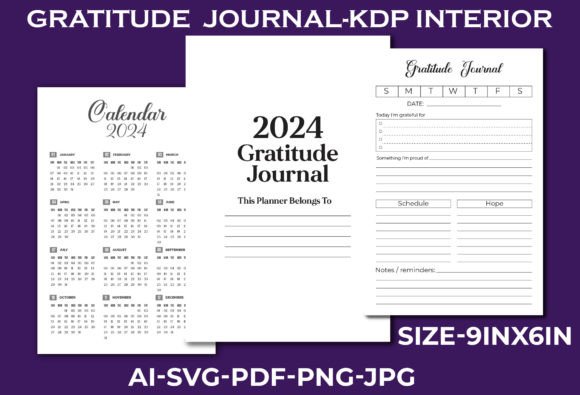
This is a black-and-white interior file, ready to upload, that stretches across 120 pages. Every spread mixes structured reflection with open note space. There is a yearly calendar for 2024 right at the front, followed by monthly schedule blocks, then daily sections that encourage both gratitude logging and gentle planning. The pages use a blend of lined and dotted note areas, so you can journal in complete sentences, scribble quick lists, or drop in small sketches—all without the page feeling like a corporate form. Because the file is a single PDF at 300 DPI with no bleed, you can send it to KDP, revise the cover, and start ordering proof copies within the same afternoon.
The "SVG" in the name often confuses first-time buyers. In practice, the interior is a complete PDF, but the design elements originated as scalable vector graphics. That matters for anyone who wants to tweak fonts, adjust the calendar layout, or pull out a page for a separate planner. Instead of starting from a blank InDesign file, you get a foundation that is easy to adapt in Affinity Publisher, Illustrator, or even free tools like Inkscape.
When a Structured Gratitude Journal Makes More Sense Than a Blank Notebook
Blank notebooks are great until you hit day 14 and realize you have written "I am grateful for coffee" five times in a row. The 2024 Gratitude Journal Svg KDP Interior works because it introduces light constraints without turning reflection into a chore. Each daily entry offers a small prompt area—such as "A moment of hope today" or "Something I learned"—plus a schedule strip where you anchor the gratitude to the actual rhythm of your week. That pairing shifts journaling from an abstract exercise into a quick, grounded check-in that busy adults can actually maintain.
People often use this interior in three distinct phases of the year. January through March, it helps new habits stick. The built-in 2024 calendar encourages you to mark milestones, not just empty dates. Mid-year, when motivation dips, the dotted note sections invite a restart because you do not have to face an entire blank page. And around November or December, the schedule feature naturally turns into a lightweight annual review: you can flip back, see what you were grateful for in March, and notice patterns you would otherwise forget.
Real People, Real Ways They Use This Interior
No two users approach the same file the same way. Here are a few grounded examples that go beyond the obvious “write what you are thankful for” advice.
- KDP publishers who want a low-maintenance listing. Instead of commissioning a custom interior from a freelance designer, a publisher can download the PDF, pair it with a cohesive cover, and launch a new journal in a weekend. The 120-page count hits a sweet spot for print cost versus perceived value, and the no-bleed setup eliminates rejection emails from KDP’s automated checker.
- Freelance coaches and wellness facilitators. A coach who runs small-group gratitude workshops often prints a handful of copies for attendees. Because the file is 6x9 inches, the journal fits easily into a purse or laptop bag. The blend of lined and dotted sections means participants can use the same book for guided exercises during the session and open-ended reflection between meetings.
- Busy parents tracking small wins. A mom with limited evening energy might fill only the calendar and schedule blocks, using the daily prompt area just on weekends. Even that partial use transforms the journal into a gentle record of family life, not another unfinished self-help book on the nightstand.
- Creative entrepreneurs bundling products. Someone who sells digital art or printable planners can take the interior, reskin a few pages with a brand palette, and offer a "2024 Creative Gratitude Kit" as a bonus for higher-tier customers. The lined/dotted structure means the functional core stays intact regardless of the color overlay.
- Educators introducing reflective practice. A high school teacher might print only the monthly schedule pages and a handful of gratitude prompts to create a mini journal for a wellness week. The 300 DPI resolution allows clean photocopying or small-batch printing without blurry lines.
Connecting the 2024 Calendar to Everyday Schedules
Many gratitude journals treat the calendar as decoration. In this interior, the 2024 calendar is functional and forward-looking. Each month’s schedule view sits directly before the corresponding daily entries. That means you can jot down important deadlines, a friend’s surgery, or a work conference right where you will later reflect. This simple layout decision turns the journal into a quiet accountability tool. You are not just listing good things; you are seeing how gratitude and stress coexist on the same Tuesday, and that is often more useful than relentless positivity.
A social media manager, for instance, might use the schedule blocks to mark content milestones and then use the evening prompt to note a small win—a comment that shifted a client’s perspective, a post that actually felt authentic. Over a quarter, the interplay of planning and reflection can reveal which tasks drain energy and which ones unknowingly feed a sense of hope. That type of real-world self-audit is hard to get from a purely guided journal or a purely blank log.
Why No-Bleed and 300 DPI Are Not Just Tech Specs
When you are preparing an interior for print-on-demand, specs like "no bleed" and "300 DPI" stop being abstract requirements and become practical safeguards. A no-bleed interior means every line, every dotted grid, and every header sits safely within the trim boundaries. You do not have to adjust margins or fear that a page number will get clipped on the bottom of a proof. For anyone who has uploaded a PDF only to have KDP flag image resolution warnings, the 300 DPI setting removes that friction. The black-and-white format keeps printing costs predictable, which matters a lot when pricing a journal competitively on Amazon or reselling through a local print shop.
There is another layer, too. Because the source was created as SVG, the line work remains sharp even if you scale the PDF for a different size later. A small business owner who decides to offer an A5 version down the road does not need to rebuild the calendar or the dot grids from scratch. The clean vector bones let you focus on layout adjustments rather than pixel-level cleanups.
Practical Considerations Before You Customize or Upload
Jumping straight into a project with this interior will save time, but a few upfront checks prevent frustration. First, confirm your KDP book setup matches the 6x9 trim size precisely. Even a small mismatch can shift the binding and make the inner margins feel off. Next, think about the cover. Because the inside is black-and-white, you can go bold with a full-color glossy cover or keep it minimal. Whatever you choose, the spine width for 120 pages will affect your cover template, so calculate that before you finalize the wrap.
If you intend to modify the file, open the PDF in an editor that supports vector elements, not just as a flat image. Some users accidentally rasterize everything and then wonder why the text looks soft on Kindle Direct Publishing's review tool. Keep the layers intact if possible, and always export a test PDF to check how the dotted lines render at print size. Dotted notes that look fine on screen can appear too faint if you apply heavy compression during export.
Also, remember that the 2024 calendar is a fixed asset. If you plan to sell this journal in 2025, you will need to update the monthly grids. That is not difficult with the SVG source, but it is a step you should budget time for. Many publishers simply re-release with a new cover and updated calendar, keeping the core gratitude structure untouched because it does not age.
Turning a Simple Interior into a Long-Term Habit Tool
Beyond publishing, you might just want a single, well-made journal for yourself. The 2024 Gratitude Journal Svg KDP Interior shines here because the dotted pages allow habit tracking without a separate app. You can sketch small icons—a water drop for hydration, an open book for reading—and place them next to the gratitude note. This hybrid analog system costs nothing beyond the initial print or digital import on a tablet, yet it sidesteps the constant distraction of phone notifications during a reflective moment.
The hope theme shows up in subtle cues rather than in-your-face affirmations. Section headers use gentle phrasing like “What I’m looking forward to” and “Unexpected good moments.” This makes the journal accessible to a wider audience, including those who feel allergic to traditional gratitude exercises. A software developer might use the evening prompt to log small technical breakthroughs, while a caregiver might jot down a moment of calm between rushed meals. Both get the same structural benefit without being told how to feel.
How Different Professionals Fold This Resource into Their Work
An Etsy seller who designs wedding stationery can quickly adapt the dotted note pages into a bridal shower gratitude journal. By overlaying a floral motif on a few pages and keeping the lined sections intact, they create a niche product without designing 120 pages from scratch. A therapist might print individual calendar months for clients who need a visual anchor during sessions, using the gratitude block as an end-of-session check-in. Small business owners who manage remote teams sometimes bulk-order printed copies of the journal to include in care packages, recognizing that a tangible item with a ready-to-use calendar does more for morale than a generic thank-you email.
Because the interior is a standard PDF, it also works on e-ink tablets and note-taking apps. Import a single page into a digital notebook, and you have an infinite gratitude log without sacrificing the calendar structure. This flexibility is rarely advertised, but it is a quiet superpower for anyone who wants to reduce paper waste or carry their journal alongside work documents.
Setting Yourself Up for Consistent Use, Not Perfection
The biggest risk with any gratitude practice is treating it like a daily test. When you miss three days, you feel you have failed the system and abandon the journal entirely. The dotted note areas in this interior help solve that. Instead of a blank, intimidating line, you see a subtle grid that invites you back in—maybe with a bullet list of three tiny things, maybe just a single word. The 6x9 size also fits into tighter corners of a desk, so it stays visible rather than getting stacked under bills.
People who pair the journal with a morning coffee or an end-of-commute check-in tend to stick with it longer. The act of opening the physical book, glancing at the monthly schedule, and then writing for two minutes creates a sensory loop that a phone note can never replicate. And if life gets overly full, using only the schedule portion to capture appointments still keeps the habit alive until the writing naturally returns.
What Sets This Interior Apart in a Crowded KDP Niche
The self-publishing space is full of gratitude journals, but many are either too sparse or overly scripted. This one lands in a useful middle: it offers 2024 calendar functionality that actually aids planning, lined plus dotted note spaces that reward different thinking styles, and a PDF structure that works instantly while still being editable at the vector level. Whether you are a first-time KDP publisher who wants to avoid technical errors, a creative professional looking for a flexible base file, or someone who simply needs a structured way to track hope throughout an uncertain year, the interior adapts instead of forcing a rigid fit.
Taking a few minutes to print a test page, validate the margins on your printer, and decide how you will use the schedule sections will pay off far more than rushing to a full print run. The file is ready. The 2024 dates are set. What you bring to the pages—whether that is a publishing plan, a quiet morning routine, or a client workshop—turns the template into something worth keeping.