Voice Mail Logbook KDP Interior: A Strategic Tool for Publishers and Professionals Alike
Every day, professionals miss important details buried in voicemail messages. A callback number gets garbled, a deadline shifts without documentation, or a client's tone suggests urgency that memory alone cannot preserve. The Voice Mail Logbook KDP Interior addresses this gap with a structured, ready-to-use format designed for Amazon Kindle Direct Publishing. It is more than a stack of blank pages. It is a decision-support instrument that helps users capture, organize, and act on voice messages with clarity. For publishers, it represents a low-content book interior that meets real market demand. For buyers, it becomes a daily companion in managing communication effectively.
Understanding the Voice Mail Logbook as a KDP Interior Product
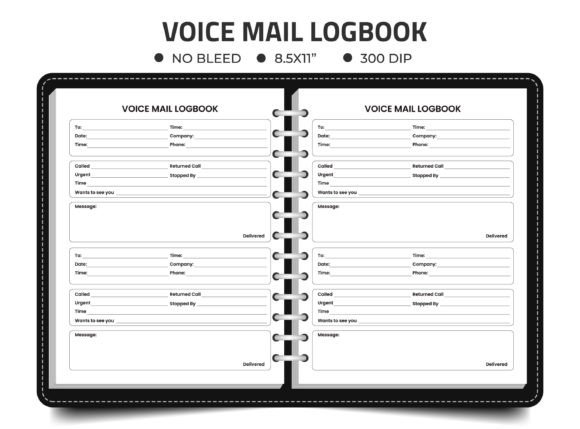
A voicemail log book KDP interior is a formatted template created specifically for self-publishing on Amazon. It typically includes fields for the caller's name, phone number, date, time, message summary, urgency level, and follow-up actions. The interior described here spans 120 pages, comes with both a JPG and a PDF at 300 dpi, and is sized at 8.5 by 11 inches with no bleed. This specification matters because it ensures print-readiness and compatibility with KDP's requirements. Publishers can upload it directly without additional formatting work, which saves hours of trial and error.
What sets this interior apart is the combination of design and function. The high-resolution output guarantees crisp text and clean lines in the printed book. The no-bleed setup means content stays safely within margins, avoiding trimming issues during production. Having been tested on Amazon KDP, it reduces the risk of rejection or formatting errors that often frustrate first-time publishers. For anyone building a catalog of telephone log book or phone call message tracker products, this interior provides a dependable foundation.
Why Professionals and Small Businesses Need a Voicemail Logbook
Voicemail remains a critical touchpoint in fields like law, healthcare, real estate, consulting, and customer support. Yet the act of listening to a message and mentally noting its contents is unreliable. Memory degrades. Details blur. A voice mail log transforms passive listening into active documentation. When a user writes down the caller's information, rephrases the core message, and notes the required response, they engage in a small but meaningful act of knowledge capture. Over weeks and months, this practice builds a searchable record of commitments, requests, and relationship moments.
Consider a freelance consultant juggling five active clients. Each voicemail might contain a scope change, a scheduling request, or a payment question. Without a centralized voice message logbook, these details scatter across sticky notes, email drafts, and memory. With a dedicated log, the consultant reviews the day's messages in one sitting, prioritizes responses, and avoids the embarrassment of forgetting a callback. The log also serves as proof of communication, which can be valuable if disputes arise about what was said and when.
Strategic Planning Through Consistent Message Tracking
A voicemail diary offers more than daily task management. Over time, patterns emerge. A business owner might notice that certain clients consistently call after hours, signaling a need for adjusted availability or an automated after-hours response. A sales professional could spot seasonal spikes in inquiry calls and plan staffing accordingly. These insights depend on consistent logging. Without a structured record, the data remains invisible.
Using a telephone record book intentionally means treating each entry as a data point. Note not just what was said, but when the call arrived, how long it took to respond, and what outcome followed. After three months of disciplined use, a manager can analyze response times, identify bottlenecks, and adjust workflows. This turns a simple logbook into a lightweight business intelligence tool. The key is consistency, and a well-designed interior makes consistency easier by providing clear, repeatable fields.
How Creators and Publishers Benefit from This Interior
For KDP publishers, the Voice Mail Logbook KDP Interior solves several problems simultaneously. First, it eliminates design complexity. The interior arrives print-ready, tested, and formatted to Amazon's specifications. Second, it targets a specific niche with clear search intent. Buyers looking for a voicemail note book or phone call logbook know what they want. They are not browsing vaguely. They are searching with purpose. A publisher who offers this product competes on relevance, not just price.
Third, this interior supports branding flexibility. Publishers can add a custom cover, adjust the title page, and position the book under their brand. The interior itself remains clean and functional, but the wrapper reflects the publisher's identity. This combination of ready-to-use structure and customizable presentation allows for faster publishing cycles. Instead of spending two weeks designing a KDP interior from scratch, a publisher can focus on cover design, keyword research, and marketing. Time shifts from production to strategy.
Practical Tips for Using the Logbook Effectively
Buyers who treat the voicemail work book as a passive repository will see limited value. Those who integrate it into a daily routine will notice compounding benefits. Here are several practical approaches:
- Set a daily review time. Choose a consistent window, perhaps mid-morning and late afternoon, to check messages and log them. This prevents backlog and keeps the log current.
- Standardize your shorthand. Develop abbreviations for common entries, such as scheduling requests or follow-up needs. This speeds up logging without sacrificing clarity.
- Assign priority levels. Use a simple system like high, medium, low. Mark urgent messages clearly. This helps when scanning the log later.
- Cross-reference with other systems. If you use a CRM or project management tool, note the reference ID in the log. This connects the voicemail record to broader workflows.
- Review periodically for patterns. Every month, scan past entries for recurring issues, frequent callers, or missed opportunities. Use these observations to adjust how you handle incoming calls.
When to Rely on a Voicemail Logbook and When to Adapt
A telephone message book works best when voicemail volume is moderate to high and the messages contain actionable information. In roles where voicemail is rare or purely informational, the log may feel like overhead. The decision to adopt this tool should follow an honest assessment of communication patterns. If you receive fewer than five voicemails per week, a simple notebook may suffice. If you handle dozens and some carry financial or legal weight, the structured log becomes essential.
Also consider team environments. A shared phone call log book works well in small offices where multiple people check messages. It creates a single source of truth and reduces duplicate callbacks. However, shared logs require clear protocols. Who updates it? How quickly? What happens if someone forgets? Without these agreements, the log can become inconsistent and lose trust. The interior design cannot solve process issues. It can only support a well-defined process.
Design Considerations That Impact Usability
The 8.5 by 11-inch format matters. Smaller books feel portable but constrain writing space. This larger size gives ample room for detailed notes, especially when messages are complex or require multi-step follow-ups. The no-bleed interior ensures that writing stays cleanly within boundaries, and the 300 dpi resolution maintains sharpness when printed. For publishers, these technical details translate directly into customer satisfaction. Buyers who receive a blurry or cramped book will not return. Those who receive a crisp, spacious log book are more likely to leave positive reviews and purchase related titles.
The 120-page count strikes a practical balance. It provides enough capacity for several months of regular use without becoming bulky or expensive to print. Publishers can adjust page counts in future variations, but 120 pages is a solid starting point that aligns with KDP's printing economics. The included JPG and PDF files offer flexibility. The PDF is print-ready, while the JPG can be used for promotional graphics or interior previews on the product page.
Avoiding the Trap of Using Tools Without Purpose
Any KDP planner, logbook, or journal can become shelf clutter if adopted without clarity. The risk is real. Someone buys the voicemail log book with genuine intent, uses it for two days, and abandons it when the novelty fades. This pattern stems not from the product but from a lack of defined purpose. Before purchasing or publishing such a tool, ask what specific problem it solves. Is it reducing missed callbacks? Is it creating a paper trail for client conversations? Is it helping a team coordinate responses? When the purpose is clear, adoption becomes easier and results become measurable.
For publishers, the parallel risk is launching a product without understanding the audience. A KDP log book that looks attractive but fails to align with how people actually process voicemails will struggle to gain traction. Study the workflows of your target customers. Talk to receptionists, executive assistants, freelancers, and small business owners. Learn what fields they need, what frustrates them about existing solutions, and what would make logging feel effortless. Then choose or design interiors that reflect those insights. The market rewards relevance, not just aesthetics.
Positioning the Logbook for Long-Term Value
A Voice Mail Logbook KDP Interior can serve as the backbone of a broader product line. Publishers might pair it with a phone call message tracker designed for specific industries, such as medical offices or legal firms. They could bundle it with a customer service training guide or a time management planner. Each spin-off deepens the publisher's catalog and strengthens their niche authority.
On the user side, the logbook's value grows over time. A year's worth of logs becomes a reference archive. When a client claims they never agreed to a change, the log provides a timestamped record of the voicemail that confirmed it. When preparing for a performance review, an employee can point to the volume and complexity of calls managed. The voicemail diary quietly transforms from a daily tool into a strategic asset. This long-term perspective changes how people approach logging. It is not a chore. It is an investment in clarity and accountability.
Making the Decision: Is This Interior Right for Your Goals?
Publishers evaluating this KDP interior should consider three factors: market demand, ease of customization, and alignment with their brand. Voicemail logbooks address a functional need that persists despite digital alternatives. Many professionals still prefer paper for quick, focused logging without screen distractions. The market exists, though it rewards thoughtful positioning over generic offerings.
Buyers should assess their current communication habits honestly. If voicemails slip through the cracks regularly, a structured telephone log book is a low-cost intervention with potentially high returns. If voicemails are already managed well through other means, adding another tool may complicate rather than simplify. The right time to adopt is when current methods show strain—missed calls, forgotten details, or team misalignment.
The product itself is ready. The Voice Mail Logbook KDP Interior with its 120 pages, high-resolution files, and tested format removes the technical barriers. What remains is the strategic decision: to publish, to purchase, to integrate. That decision, made with clarity and intention, determines whether the logbook becomes a valued resource or another unused tool. Choose deliberately, and the results will follow.