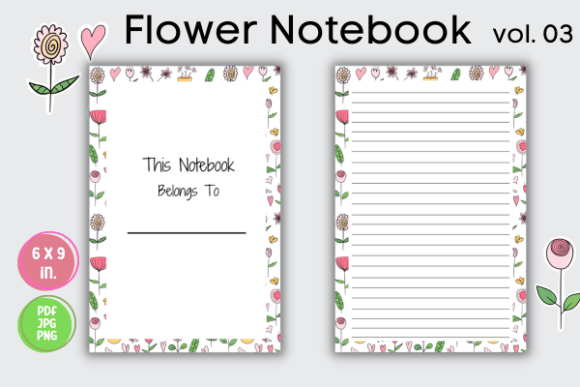
Flower Notebook Journal Vol. 3 for Creative Projects
There's a quiet confidence that comes with a well-chosen notebook interior. Not the cover everyone sees on a shelf, but the pages inside—the part a user actually lives with. Flower Notebook Journal Vol. 3 understands that distinction. It's a low-content book interior built for KDP publishers and printable product creators who want something gentler than a stark bullet journal, cleaner than heavily illustrated pages, and flexible enough to work across multiple markets.
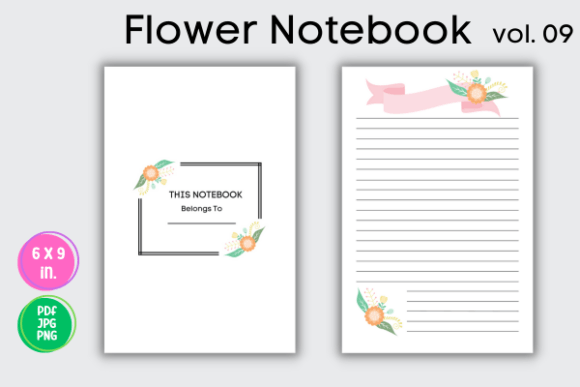
The set includes a 100-page PDF, two PNG files, and two JPG files. Inside you'll find a "This notebook belongs to" page and a beautifully simple lined page. The design uses white cards set within a colored frame—a restrained floral border that defines the visual personality without shouting. Think of it as architectural rather than decorative. The frame creates boundaries, the white card centers the writing space, and the floral elements offer just enough softness to shift the tone away from corporate coldness toward something more personal.
For KDP publishers, this kind of interior solves a specific problem. You can design an extraordinary cover, but if the inside feels disconnected or visually chaotic, returns climb. The colored floral frame bridges that gap. It lets the interior feel designed rather than default. It signals intent. And because the PDF is print-ready, you're not wrestling with margin settings or worrying about trim edges. You upload, preview, publish.
Where This Interior Makes the Most Sense
Not every notebook interior fits every project, and honestly, that's a good thing. The floral-framed card design has a clear point of view. It leans toward audiences who appreciate a bit of warmth in their stationery—planners, journaling communities, gardeners, herbalists, creative writers, and anyone who finds standard ruled notebooks too institutional.
Some of the strongest use cases include:
- Guided journals aimed at women over 30 who want something elegant without being fussy
- Recipe notebooks where the floral framing echoes a kitchen garden aesthetic
- Gratitude journals positioned in the wellness and mindfulness space
- Poetry or personal reflection notebooks where the visual softness supports the writing mood
- Custom-branded notebooks for florists, event planners, or boutique stationery shops
The lined page interior is straightforward enough that you can add your own prompts, headers, or section indicators if you want to customize further. Because the frame sits on a white card, you have a clean canvas inside the decorative border. That adaptive quality is what makes this more versatile than it first appears.
Why the Framed Card Approach Works
There's a reason interior page design matters beyond aesthetics. When someone opens a notebook, the layout either disappears into the background or creates friction. A colored frame with a white card center does something psychologically interesting—it focuses attention inward while defining the edges of the usable space. Your handwriting stays contained. The margins feel intentional rather than arbitrary.
From a publishing standpoint, this design also affects how the interior photographs. If you're selling on Amazon KDP or Etsy, listing images matter as much as covers. The "This notebook belongs to" page gives you a natural opening spread to feature in mockups, and the bordered pages photograph with structure. There's depth. The frame adds contrast against the white card, so even flat-lay photos read clearly on mobile screens.
For printable sellers, the dual-format files are practical. The PNGs give you transparent backgrounds for overlaying in Canva or Photoshop if you want to build covers or promotional graphics that mirror the interior style. The JPGs drop easily into documents, product previews, or bundled packages. You get visual consistency across your product listing without needing to design matching elements from scratch.
Practical Considerations for Publishers and Creators
Before you commit to any interior template, run through a few checks. First, consider your trim size. A 100-page interior formatted for 6x9 inches won't directly translate to 8.5x11 without scaling issues. Know your final dimensions and verify the file matches. The PDF included in this set is ready for standard paperback KDP sizes, but always confirm during upload.
Second, think about your audience's writing style. The lines appear cleanly spaced, suitable for typical adult handwriting. If you're targeting an audience that writes small or uses fountain pens with broader nibs, the spacing still holds up well based on the samples. For markets where users tend toward large, looping handwriting, you might want to test readability by printing a single page at home before ordering proofs.
Third, consider how you'll present brand identity through the interior. The floral frame carries a certain botanical softness. If your cover design leans ultra-modern, minimalist, or industrial, you'll need to bridge that aesthetic gap. The frame itself acts as a brand cue. It suggests approachability, care, and a personal touch. Pair it with covers that share that sensibility rather than fighting the interior tone.
Commercial usage is straightforward. These files are designed specifically for KDP interiors and printable product creation. You can use them in books you sell, printables you offer, or bundled products you develop. As with any design asset, double-check the specific license terms that come with your purchase, but the intent is clearly commercial—build notebooks, publish journals, create products.
How This Fits Into a Broader Publishing Strategy
Low-content publishing rewards efficiency, but only when efficiency doesn't sacrifice perceived quality. Shoppers on Amazon or Etsy flip through interior previews. They look at the "Look Inside" feature. If your interior looks generic, the perceived value drops, even if the cover is gorgeous. A semi-custom interior like the Flower Notebook Journal Vol. 3 offers a middle path—you get a professionally designed page layout without commissioning original work for each title.
For publishers running multiple niches, this approach supports brand consistency across product lines. You can use the same interior across a series of journals with different covers, building a recognizable product family. The colored frame becomes a visual signature. Customers who buy one notebook and enjoy the interior experience will recognize the same design sensibility when they purchase another title under your brand.
If you're newer to publishing, this kind of interior also reduces decision fatigue. You're not agonizing over line spacing, margin widths, or whether the design feels balanced. Someone already solved those problems. You focus on covers, keywords, categories, and marketing—the levers that actually move sales.
Expanding Beyond Notebooks
The pages have applications outside traditional journals. Consider using individual pages as part of planner bundles, printable stationery sets, or digital journaling kits. The PNG files make it easy to pull a single page into a broader product without reformatting everything. You could build a morning routine bundle that includes a daily planner page, a gratitude prompt, and a lined reflection sheet using this interior as the reflection component.
Membership site owners and course creators might use these as workbook pages within downloadable modules. The floral framing softens what could otherwise feel like homework, making reflective exercises more inviting. It's a subtle shift, but design psychology matters when you're asking someone to sit down, slow their thinking, and write by hand in a world full of typing.
Crafters working on physical products can print and bind these pages into handmade journals, sell them at markets, or offer custom bookbinding services using the interior as a foundation. Because the design works across both print-on-demand and physical crafting workflows, the asset stretches beyond a single business model.
Final Thoughts for Fellow Publishers
Assets like the Flower Notebook Journal Vol. 3 are the quiet infrastructure of a solid publishing catalog. They won't make headlines. They won't trend on social media. But they will reduce returns, improve the customer experience, and let you ship products faster without cutting corners on the inside experience. For anyone building a low-content publishing business, that's worth far more than another cover template.
Look at your upcoming projects. Where would a soft, framed interior elevate the product? Where have you been using blank or basic lined pages that could benefit from just enough design to feel intentional? This interior fills a specific creative need—not for everyone, but for the right products, it makes a genuine difference in how the finished book feels in someone's hands.