Children Number Tracing Pages 13 14: A Practical Gateway to Early Math Confidence
Every parent and early educator knows the moment: a child proudly holds up a scribbled number, eyes bright with discovery. That blend of motor skill, memory, and sheer joy doesn’t happen by accident—it grows from purposeful, repeatable activities. Children Number Tracing Pages 13 14 captures this perfectly, offering a print-ready KDP resource that turns 1 to 10 number tracing into a calm, engaging daily ritual. When you combine clear layouts, finger-counting cues, and colouring invitations, you get far more than a worksheet. You get a quiet system that builds number sense, pencil control, and a genuine love for learning—all formatted for the realities of modern self-publishing and home education.
The title itself—Children Number Tracing Pages 13 14—hints at a specific sequence within a larger learning journey, but the product’s heart lies in its simplicity. It is a ready-to-upload Amazon KDP file designed for kindergarten and preschool settings, stripped of unnecessary complexity and built around how young brains actually absorb numerical concepts. It respects the 8.5 x 11 inch paper standard and the no-bleed requirement that makes printing effortless, whether for a classroom or a living room table.
Why Number Tracing Remains a Cornerstone of Early Numeracy
Long before children memorise addition facts, they need to internalise what “four” looks like, how it sits on a line, and how their hand moves to create it. Tracing does this quietly and effectively. When a child traces the number 3 repeatedly, motor memory fuses with visual recognition, building a bridge between abstract symbol and physical action. This isn’t a new idea, but its endurance in early childhood education speaks to how reliably it works.
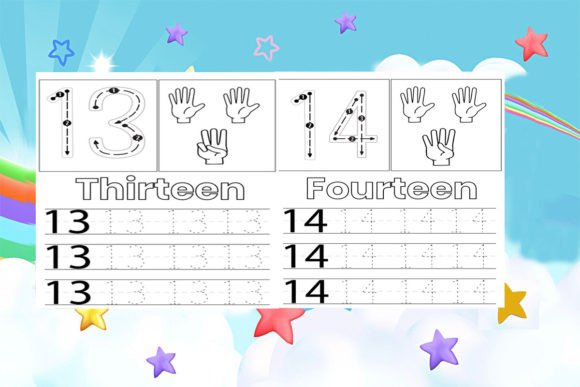
Modern learning environments increasingly value multi-modal engagement. The Children Number Tracing Pages 13 14 set doesn’t stop at tracing. Each page weaves in finger-counting illustrations, inviting children to hold up their own fingers and connect quantity with symbol. This kinesthetic layer grounds the activity in concrete experience—a principle Montessori and mainstream pedagogy both endorse. And then there’s colouring: a seemingly simple addition that actually strengthens fine motor grip and keeps frustration low. By colouring the numbers after tracing, a child feels a sense of completion and ownership, turning a drill into a little art project.
The Rise of Print-Ready KDP Resources and What It Means for Creators
The self-publishing landscape, especially through Amazon KDP, has rewritten how educational materials reach families. Low-content and medium-content books—journals, planners, and tracing workbooks—aren’t a passing trend; they’ve become a stable, demand-driven niche. Parents actively search for “number tracing book ages 3-5,” “preschool math workbook,” or “kindergarten number practice,” and they expect crisp, ready-to-use interiors. This is where a file like Children Number Tracing Pages 13 14 fits seamlessly. It arrives as a source package containing a PDF, two PNG files, and an AI file, giving sellers immediate flexibility to upload, tweak, or brand the product without starting from scratch.
For educators-turned-creators, stay-at-home parents launching a side hustle, or graphic designers building a portfolio, such print-ready files reduce the barrier to entry dramatically. You don’t need to master complex layout software or spend hours guessing dimensions. The work respects the 8.5 x 11 inch no-bleed standard, which means no content gets clipped during printing. That single detail prevents customer complaints and returns—a practical reality that anyone who has sold on KDP understands deeply.
What “Source Files Included” Actually Unlocks
The phrase “source files included” can sound like jargon, but in daily use it means creative control. Getting a PDF, two PNG files, and an AI file in one bundle lets you:
- Make quick colour adjustments or add your brand name using the editable AI file.
- Use the high-resolution PNGs to create social media previews or product mockups without hunting for separate assets.
- Print a test copy directly from the PDF to check paper feel and child usability before listing.
This isn’t about unlocking wild customisation; it’s about removing friction. When you test a page with a real four-year-old and notice the dotted line could be slightly darker, having the AI file means a five-minute edit rather than a redesign. That responsiveness builds better products and better reviews.
How Young Learners Connect Tracing, Finger Counting, and Colouring
A typical page from this set unfolds in three gentle stages. First, a child sees a large, bold number outline—say, the number 7—with directional arrows or dotted guides. As their crayon or pencil follows the path, they aren’t just copying; they’re internalising the stroke order that will later make handwriting automatic. Second, they look at a hand illustration showing seven fingers raised. This bridges the symbol and the real-world quantity, a step often skipped in overly abstract worksheets. Third, they get to colour the numbers, transforming the traced form into their own creation. This progression keeps motor fatigue low and interest high, especially for children who wiggle out of desk-based work quickly.
Educators note that combining tracing with finger counting improves subitizing—the ability to recognise small quantities without counting one by one. While a worksheet alone won’t teach subitizing, repeated exposure to hand images alongside numerals primes the brain to associate “five fingers” with the numeral 5 on sight. It’s a subtle but cumulatively powerful effect.
Designing for the Living Room Table and the Classroom Shelf
Practicality shapes every good learning tool. The no-bleed 8.5 x 11 inch layout means parents can print on standard letter-sized paper without hunting for special settings. Whether they use a home inkjet printer or send the file to a local copy shop, the pages come out clean, margins intact. Teachers appreciate this because they often batch-print forty copies on a Monday morning; a bleed-free file eliminates the nuisance of trimming or rescaling.
Another often-overlooked benefit is the visual calm of the design. Pages that try to pack too many elements—stickers, distracting backgrounds, multiple activities—can overwhelm a four-year-old still learning to focus. The Children Number Tracing Pages 13 14 keep the spotlight on the core task. One number, one set of tracing lines, one hand illustration, and a colouring invitation per page. That restraint isn’t boring; it’s developmentally respectful.
Who Benefits Most from This Print-Ready File
The obvious audiences are preschool teachers and parents of three- to five-year-olds. But the modern ecosystem includes several other groups that find immediate value:
- KDP entrepreneurs building a series of early learning workbooks. A reliable tracing interior lets them focus on cover design, keyword strategy, and marketing, rather than reinventing basic content.
- Homeschooling co-ops looking for affordable, reproducible materials that don’t require a subscription. A single purchase of the file allows unlimited prints for personal or small group use, making budgeting straightforward.
- Occupational therapists who address fine motor delays. The thick dotted lines and large number outlines provide a forgiving canvas for children developing grip strength and hand-eye coordination.
- Childcare centers that rotate themed activities monthly. Because the pages are black-and-white friendly, they save on coloured ink while still inviting children to add their own creative flourishes.
In each case, the core demand is the same: a thoughtfully sequenced, no-fuss number tracing experience that respects a child’s developmental stage and an adult’s limited time.
Realistic Observations on the “Enjoy Learn Easily” Promise
The description says, “Children Enjoy learn easily through this pages.” There’s no magic here, but there is a well-understood principle: when a task matches a child’s emerging skills and offers a small, tangible reward (like colouring), frustration decreases and willingness increases. A four-year-old won’t suddenly master number formation in an afternoon. However, with daily five-minute sessions using clean tracing pages, most children show noticeable improvement in grip, stroke consistency, and number recognition within two to three weeks. The key is consistency, not intensity—and a printable file makes consistency affordable and convenient.
Ease also comes from the counting fingers element. Children who struggle to connect the spoken word “three” to the symbol 3 often find a visual hand much more intuitive. They can look at the hand on the page, then at their own hand, mirroring the gesture physically. This embodied cognition isn’t a gimmick; it’s a research-backed pathway for early math grounding.
Where This Sits in the Broader Trend of Hybrid Learning Tools
The world hasn’t abandoned digital learning apps, but a quiet correction is underway. Parents and teachers increasingly recognise that screen time, even educational screen time, doesn’t build the pencil-grip muscles needed for writing. Printables straddle both worlds: you can discover them online, download them instantly, but then the learning happens entirely offline, on paper, with movement and touch. This hybrid model respects screen-fatigue realities while embracing the convenience of digital delivery.
For a KDP publisher, this means the market for print-ready tracing files remains robust. It isn’t a gold rush, but steady. A well-keyworded listing for a “1 to 10 number tracing book for toddlers” can generate consistent monthly sales, especially when the interior genuinely helps children. Amazon’s own algorithms increasingly reward content that leads to positive user experiences and low return rates. A high-quality, no-bleed interior contributes directly to that goal.
A Note on Competition and Quality Signals
The KDP low-content space is crowded with hastily assembled interiors. Standing out doesn’t require over-the-top innovation; it often comes down to small quality signals: clean spacing, intuitive page flow, and source file usability. The Children Number Tracing Pages 13 14 product positions itself in that reliable middle ground—professional enough to earn good reviews, simple enough to use without confusion. For creators, that’s a strategic sweet spot.
Practical Ways to Extend the Learning Without Extra Worksheets
One of the smartest uses of these pages is as a springboard. After a child traces and colours the number 5, a parent might ask, “Can you find five toys?” or “Let’s hop five times.” This moves the learning from two-dimensional to whole-body, reinforcing the finger-counting connection made on the page. The worksheet becomes the anchor, not the entire lesson. That approach also keeps the parent or teacher actively engaged, which research consistently shows to be the variable that matters most in early learning outcomes.
Similarly, educators can repurpose the pages into a gallery of student work. Children love seeing their coloured numbers hung on a wall or taped into a book. The simple act of displaying their efforts builds confidence and a growing identity as “someone who can write numbers.” That emotional layer shouldn’t be underestimated. The tracing pages become more than skill practice; they become part of the child’s learning story.
Understanding the File Delivery: PDF, PNG, and AI in One Package
When you purchase this print-ready resource, you receive a tightly organised set of files that reflect a clear understanding of how creators work. The PDF file is the ready-to-upload hero; it’s press-ready for KDP or for instant home printing. The two PNG files offer high-resolution raster versions that work perfectly for promotional images, blog post visuals, or previews on classroom sharing platforms. The AI (Adobe Illustrator) file is where customisation lives—adjust line thickness, swap fonts for a handwriting style you prefer, or extract individual elements for use in other projects.
This three-format delivery isn’t just generous; it’s functional. It respects the fact that a seller might need to make region-specific tweaks (like adding a bilingual instruction), or a therapist might want to enlarge the numbers and print on A3 paper without losing clarity. Having vector and raster options eliminates guesswork and speeds up the path from download to listing or lesson.
Maintaining Quality Without Overcomplicating the Creative Process
There’s a quiet elegance in sticking to a proven formula: one number per page, clear tracing guides, a counting hands visual, and a colouring element. It resists the temptation to cram phonics, shapes, or sight words onto the same sheet—a common mistake that dilutes the learning focus. The Children Number Tracing Pages 13 14 package proves that targeted, simple resources often outperform all-in-one workbooks because they align exactly with a specific developmental goal. For entrepreneurs, this also means the product can be listed under several long-tail keywords—“number tracing with finger counting,” “colouring numbers for preschool,” or “1 to 10 tracing book”—without misleading customers.
This kind of integrity matters more as platforms refine their search algorithms. Amazon’s Helpful Content updates encourage detail and specificity. A product page that clearly explains, “This workbook includes tracing numbers, counting number with fingers, and colour the numbers” mirrors what’s actually inside and matches what buyers genuinely want. It builds trust before the customer even opens the cover.
When a printable avoids hype and focuses on use-case accuracy, it tends to attract the right audience: adults who value quiet, effective learning tools over flashy promises. And those adults leave the kind of reviews that keep a KDP title discoverable. The entire cycle—simple design, honest listing, positive experience—feeds a sustainable micro-business.
Making the Most of “Children Number Tracing Pages 13 14” in Your Own Context
Whether you’re a parent trying to prep a child for kindergarten math, a teacher refreshing the classroom math centre, or a KDP publisher building a cohesive early learning brand, the same advice applies. Start by printing a single page and observing how the child interacts with it. Notice if the dotted lines are within their fine motor reach, if the finger-counting visual clicks, and whether the colouring step holds their attention or feels like busywork. Use that observation to decide pacing—maybe just one number a day, with plenty of conversation around it.
For sellers, consider bundling. The Children Number Tracing Pages 13 14 can become a standalone title, but it can also sit alongside a 1-20 book, shape tracing pages, or alphabet practice sheets to create a full early learning series. The AI file makes it easy to maintain design consistency across products, a factor that builds brand recognition and customer loyalty over time.
Above all, remember that the best early learning resources don’t do the teaching. They create a calm, repeatable structure in which a child feels safe to try, make mistakes, and try again. The blend of tracing, finger counting, and colouring in this file achieves exactly that—without asking the adult for any specialised training or expensive supplies. In a world of complicated parenting and teaching solutions, that quiet simplicity continues to win.